

The art of making a red wine
Red wine production starts by the grapes is harvested by hand or by machines. Harvesting by hand is preferable to harvesting using machines because the hand-harvested grapes are usually in much better condition when they arrive at the winery than those who have been harvested by machines. In addition, hand harvesting enables careful selection of grapes both in the field, during harvest, and in the winery, before destemming. If harvesting is done by hand, the grapes are destemmed after they arrive at the winery, while if harvesting is done with the help of machines, the grapes are destemmed before they arrive at the winery, i.e. the destemming takes place during the harvest.

The grapes are harvested by hand
Crushing and destemming start by the grapes are filled into a container where a motor-driven screw feeder continuously presses the grapes against rubber rollers. The rubber rollers gently crush the grapes and the grapes then fall into a destemming chamber. The destemming chamber has a drum with a bunch of circular holes in it and a rotating destemming shaft with blades. Immediately after destemming, the grapes fall through the holes into a large container. The stems themselves are rotated through the drum by the destemming shaft with blades until they come out at the end of the machine where they fall onto the ground or into a container. Some winemakers use the stems during the fermentation, for example some winemakers in Châteauneuf-du-Pape (Rhône Valley), but most winemakers do not use them because the stems increase the roughness of the wine during the fermentation process.
After the crushing and the destemming, the grape mass, which consists of crushed grapes and grape juice, is pumped into an oak fermenter or stainless steel fermenter. To improve the sugar- and acid content, some winemakers add sugar or concentrated grape must (colder wine-growing areas), or tartaric acid (warmer wine-growing areas) to the grape mass. Now, the grape mass must be protected from bacteria and too much oxygen, the rate of oxidation must be kept under control, and this is done by adding a small dose of sulphur to the grape mass.
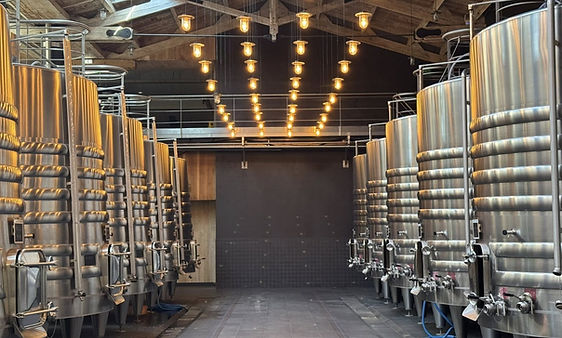
Stainless steel fermenters (stainless steel tanks)
To get more colour, more flavour and more tannins, most winemakers usually macerate, i.e. let the skins remain in the grape mass (the must) and leach out. The maceration time can vary from a few days to a month and the longer it is, the fuller, darker, tannin richer and more long-lived the wines are. The problem that arises during maceration is that carbon dioxide, which is created during the maceration, brings the skins to the surface where the skins form a skin mass (chapeau). This skin mass must be mixed with the grape mass (the must) and this is done by pressing it down with the special rods (pigeage) or by the pumping over method (remontage) or by the rotating steel tanks, etc.
There are three types of maceration: 1. Cold maceration (before fermentation) that takes place at 4°C to 15°C (often 5°C to 10°C). The cold maceration is used for a few days before alcoholic fermentation starts to get more fruitiness and colour without getting prominent tannins. 2. Traditional maceration (during fermentation) that takes place at 20°C to 32°C (optimally around 25°C to 29°C). And 3. Carbonic maceration that takes place in an oxygen-free environment at around 30°C to 32°C. The carbonic maceration is a winemaking method where whole bunches of grapes are placed in a carbon dioxide-filled stainless steel tank. It produces fruity and soft wines without heavy tannins.
It can take from a few hours to several days before the fermentation, which already begins during maceration, is in full swing. Two different types of yeast are used in wine fermentation: the natural yeast, which comes from vineyards and is found on the grape skins, and cultivated yeast. During the fermentation, the must’s sugar is converted into alcohol with carbon dioxide and heat as by-products. The fermentation usually stops when the sugar runs out, the alcohol content reaches a level that yeast cultures cannot tolerate (normally 15% to 16%, although some yeast cultures survive 20% to 22%), if the temperature exceeds 36ºC or if there is a lack of oxygen. Red wine normally ferments at 20ºC to 32ºC, and the best temperature for red wine fermentation is 29ºC. Regarding fermentation temperature, the following can be said: the higher the fermentation temperature (shorter fermentation), the more colour, flavor and tannins the wine will have, the lower the fermentation temperature (longer fermentation), the better the freshness and fruitiness of the wine. Because the fermentation temperature is so important, it is usually regulated by the fermentation taking place in temperature-controlled stainless steel fermenters (steel tanks) or, when the fermenting taking place in oak fermenters, by temperature-controlled wine cellars. During the fermentation, it is very important that the grape mass (the must) gets sufficient oxygen and this is achieved by pumping the grape mass (the must) alternately from one fermenter to another. When the sugar runs out or the alcohol content reaches a level that the yeast cultures cannot tolerate, the fermentation stops, i.e. the must has become wine.

Pressing with special rods (pigeage)

The pumping over method (remontage)
When the tap of the fermenter (made of oak, concrete, clay or stainless steel) is opened, the wine begins to flow out and this wine is called free-run wine. The remaining mass of grape juice, pulp, grape skins and seeds is pressed and it gives a dark and very tannic wine called press wine. The wines are now poured, one by one, into steel tanks or oak barrels where they undergo malolactic fermentation, i.e. fermentation that converts the sharp malic acid in the wine into the softer lactic acid.
Whether winemaker should let the wine matures in stainless steel tanks or in oak barrels is determined by the type of wine the winemaker wants. The aging in steel tanks does that the wine retains its grape aroma, grape flavour, tartaric acid, tannins and freshness better, while the aging in oak barrels does that the wine's flavour becomes more concentrated, rounded, less or more tannin rich, and that the different aromas and flavours of the oak emerge. In addition, an oak barrel can both add tannins to non-tannin rich wines and absorb tannins from very tannin rich wines. It all depends on from which country the oak barrels come from. The oak barrels from France and Croatia can both add tannins to non-tannin rich wines and absorb tannins from very tannin rich wines, while the oak barrels from the USA absorb tannins and give more sweet-spicy aromas and flavours to the wine.
Now, it is time to blend the wine, and by that it means mixes up the free-run wine with the pressed wine, to give more flavour and austerity, mixes up different oak barrels or different stainless steel tanks, mixes up wines from different grape varieties, mixes up wines from the best locations, etc. After the blending, the wine may be allowed to mature for several more months or even several more years in oak barrels or stainless steel tanks.
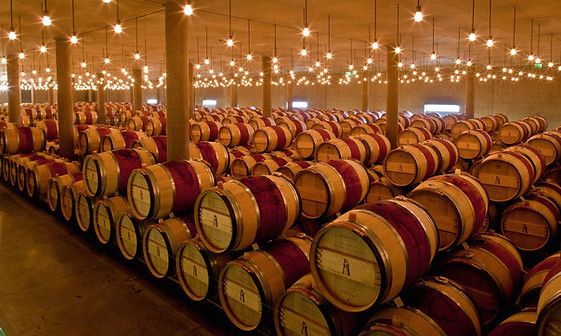
Aging in new oak barrels
To prevent the wine from being cloudy, clarification is used. The most common clarifying agents are egg white, bentonite (clay that consists mainly of minerals, usually formed by the decomposition of volcanic ash or tuff, or sometimes by the weathering of igneous or sedimentary rocks) and gelatine.
To ensure that the wine is stable, i.e. to prevent that the wine begins to ferment in the bottle, the filtration is used to remove any yeast residue and bacteria. The most common filtration methods are soil filtration by using diatomaceous earth (a soil that consists of fossilized shells of microscopic diatom algae) or perlite (a porous white volcanic glass material), compressed cellulose pads, membrane filtration, chamber filter presses and membrane filter presses. The problem with filtration is that it can remove some of the wine's fullness, complexity and flavor.
Note that many traditionally made wines do not need to undergo the fining and the stabilization. The wines are naturally completely stable, often thanks to that they have been aged in oak barrels for a long time.
The final stage in red wine production is bottling. The most important thing about bottling is that the wine and the bottles must not contain any living yeast cells and bacteria and that no air must enter the bottle. After the bottling, there is usually air between the wine and the cork and that is why wines are bottled with a certain amount of sulphur. There are wines that are bottled without added sulphur, mainly in the category of natural wines (as few pesticides and chemicals as possible in the vineyard), in France they are called “Vin Mèthode Nature”, organic wines (it is forbidden to use artificial fertilizers and chemical pesticides) and biodynamic wines (a stricter form of organic farming/organic wines).
Before the wines are released on the market, they are aged in the bottle for a shorter period, a few days or a few months, or for a longer period, a year or several years.


NJ Wines
 |  |  |  |  |  |
|---|